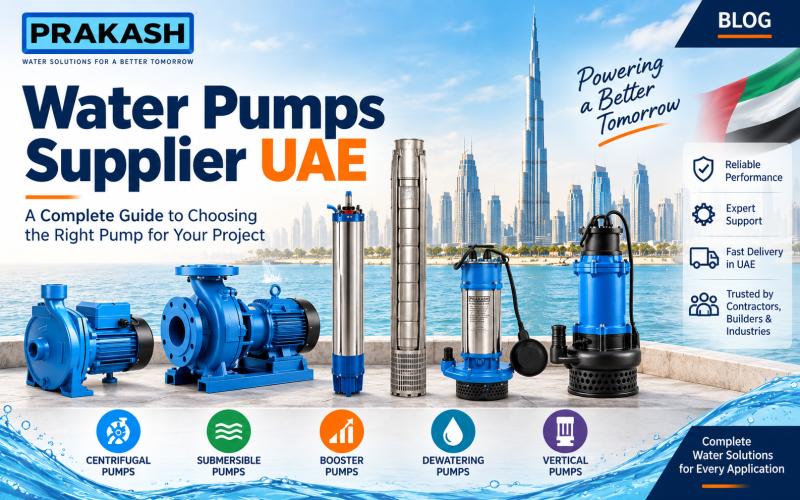
Which Pump is Suitable for Which Application? A Complete Guide by Prakash Pump
 By Prakash Pump
 Feature Blog
 June 11, 2026
Let's be honest — buying a pump feels simple until it isn't.
You walk into a store, ask for "a water pump," and suddenly you're staring at a wall of options with names you've never heard. Submersible. Centrifugal. Monoblock. Self-priming. Booster. And somewhere in the back of your head, you're already dreading the day you'll face water pump problems you don't know how to solve.
At Prakash Pump, we've spent decades helping homes, farms, factories, and construction sites find the right pump for the right job. And we'll tell you something every engineer knows but nobody says out loud:
A wrong pump doesn't just underperform — it breaks faster, costs more, and frustrates everyone.
So let's fix that. Here's a straight-talking guide to which pump fits which application — and what to watch for when things go wrong.
1. The Water Supply Pump — For Homes & Apartments
Best Pumps Type: Monoblock Pumps & Centrifugal Pumps
If you're filling an overhead tank, running taps on multiple floors, or dealing with low water pressure pump issues in your building, a monoblock pump is likely your first and best friend.
These pumps sit above ground, are easy to install, and work well when the water source is within a few feet below the pump level. They're also one of the most common subjects of pump troubleshooting calls we receive — usually because someone picked a pump with the wrong head capacity for their building height.
Quick rule of thumb: For every floor you want to pump water up, you need roughly 3–4 metres of head pressure. A two-storey house needs a pump with at least 20–25 metres of total head. Under-spec it and you'll forever be dealing with low water pressure pump complaints from the top floor.
Common issues:
- Pump runs but no water comes out → air lock or suction pipe leak
- Low flow → worn impeller or wrong pump size
- Pump overheats → running dry or blocked discharge
2. The Borewell Pump — For Deep Underground Sources
Best Pump Type: Submersible Pump
If your water source is 20, 50, or even 200 feet underground, a submersible pump is not optional — it's the only practical solution. These pumps are installed directly inside the borewell, submerged in water, which keeps them cool and primed at all times.
This is also where submersible pump repair becomes a topic of real concern for most owners. Since the pump lives underground, you can't always see what's wrong. The most common complaints we hear:
- Pump not pumping water despite the motor running — often a worn impeller, broken shaft, or sand ingress into the pump body
- Motor trips repeatedly — usually a sign of voltage fluctuation, dry running, or a failing capacitor
- Water pressure gradually drops over months — classic sign of wear on the impeller or a reduction in borewell yield
Prakash Pump's submersible range is built with sand-resistant seals and stainless-steel impellers precisely because Indian borewell water is rarely crystal clear. A pump that can't handle fine particles will give up in a season.
Pro tip from our field team: Never run a submersible pump dry — even for a few minutes. It's the single biggest reason for premature motor burnout. Always install a dry-run protection relay.
3. The Agricultural Pump — For Irrigation & Farming
Best Pump Type: Open-Well Submersible or Centrifugal Pump with High Flow Rate
Agriculture is a different beast. Farmers don't need high pressure — they need volume. Moving thousands of litres per hour across fields, filling ponds, running drip systems — this is high-flow, moderate-head territory.
Open-well submersible pumps work beautifully here because open wells and farm ponds have variable water levels that a surface pump struggles with. When the monsoon fills the well, water level rises. In April, it drops. A submersible handles both gracefully.
Centrifugal pump maintenance matters more in agricultural settings than anywhere else because these pumps work long hours in dusty, outdoor conditions. At Prakash Pump, we recommend:
- Checking shaft seals every season
- Cleaning strainers before each irrigation cycle
- Lubricating bearings every 500 operating hours
- Inspecting impeller wear annually, especially if pumping water with sediment
Neglect these basics and what starts as low water pressure pump symptoms will eventually become a full motor failure right in the middle of sowing season. Not a good time.
4. The Booster Pump — For Apartments & Multi-Floor Buildings
Best Pump Type: Pressure Booster Pump with Pressure Tank
Here's a scenario every apartment owner recognizes: ground floor has great pressure, but by the time water climbs to the fourth floor, it's barely a trickle. This is a low water pressure pump problem — but the solution isn't always replacing your main pump.
A booster pump is a small, intelligent pump installed in the pipeline to increase pressure on demand. Modern booster pumps come with built-in pressure sensors and variable-speed drives that automatically kick in when someone opens a tap and shut off when the system is idle.
They're quiet, compact, and energy-efficient — and one of the smartest investments for any housing society dealing with uneven water pressure complaints.
Watch out for: Waterlogged pressure tanks (loss of air cushion causes the pump to short-cycle repeatedly, wearing out the motor fast) and scale buildup in areas with hard water.
5. The Industrial & Construction Pump — For Dewatering & Heavy Duty Use
Best Pump Type: Dewatering Submersible Pump or High-Head Centrifugal Pump
Construction sites collect water. Basements flood. Mines need continuous drainage. In these applications, the pump isn't moving clean water — it's dealing with muddy, debris-laden slurry that would destroy a regular household pump in minutes.
Dewatering pumps are engineered for this abuse. Wide passage impellers, heavy-duty cast iron bodies, and semi-open designs allow solids and silt to pass through without jamming the pump.
Centrifugal pump maintenance in industrial settings must be more disciplined — bi-weekly inspection of wear rings, seals, and couplings. One missed maintenance cycle in a high-usage environment can mean days of downtime on a job site.
At Prakash Pump, we've deployed solar pump systems in some of UAE's most water-stressed regions, and the results speak for themselves — communities that once spent hours fetching water now have it running at a tap.
Common Pump Problems — And What They're Really Telling You
Before you call for service, here's a quick pump troubleshooting reference that can save you time and money:
| Symptom | Likely Cause | Action |
|---|---|---|
| Pump not pumping water | Air lock, broken impeller, suction leak | Check suction pipe joints; prime the pump |
| Low water pressure pump output | Undersized pump, worn impeller, partial blockage | Measure actual head vs. pump spec; inspect impeller |
| Motor tripping frequently | Overload, dry running, voltage issues | Install dry-run protection; check voltage stability |
| Loud vibration or noise | Cavitation, loose bearings, misalignment | Check inlet pressure; tighten mountings |
| Pump runs but no flow | Closed valve, broken shaft, reversed motor rotation | Check valve positions; verify motor rotation direction |
| Submersible pump repair needed repeatedly | Sand ingress, corrosion, poor quality pump | Upgrade to sand-resistant model; check water quality |
So, Which Pump Do You Actually Need?
Here's the simple version:
- Home water supply (overhead tank) → Monoblock / Self-Priming Pump
- Borewell water (deep source) → Submersible Pump
- Farm irrigation (high volume) → Open-Well Submersible or Agricultural Centrifugal
- Apartment pressure issues → Booster Pump
- Construction / basement dewatering → Dewatering Submersible Pump
- Industrial / factory use → Heavy-Duty Centrifugal Pump
Why Prakash Pump?
We don't just sell pumps — we understand water. Every application is different, every water source has its own character, and every customer deserves a solution that actually works, not just one that fits a brochure.
Whether you're troubleshooting an existing pump, planning a new installation, or trying to finally solve that low water pressure pump issue that's been bothering you for years — our team is here to help.
Prakash Pump — Engineering Water Solutions That Last.
Visit our stores to explore our full product range.